
Most short-term rental furniture gets bought from a photograph and judged by a photograph. It looks right in the catalog, it looks right on delivery day, and then it spends the next two years being used by people who did not pay for it and will not own it. The pieces that fail are almost never the ones that looked wrong. They are the ones that looked fine and were built for a house where one family uses them carefully.
Furnishing for durability is not the same as furnishing for austerity. A rental still has to photograph well, because the photo is what sells the booking. Photographing well should simply be the second filter, not the first. Decide what survives, then buy the best-looking version of that.
The photo test asks whether a piece reads as warm, current, and worth the nightly rate in a gallery someone scrolls in seconds. That test is real, and a rental that fails it does not get booked.
The turnover test asks what the photo cannot see: what happens to this piece when a cleaner needs to reset it under time pressure, when a guest sets a wet glass on it, when a suitcase rolls into it, and when all of that repeats week after week without the owner in the room. Most furnishing mistakes trace back to an owner who ran the first test carefully and never ran the second one at all. A boucle accent chair, a light oak veneer dresser, a jute rug — each is a fine choice in a primary residence and a slow, expensive problem in a rental.
Owners worry about fabric wearing thin. That is rarely what happens. What happens is a single stain that will not come out — red wine, self-tanner, makeup, a dog — on a sofa whose cover is sewn on and cannot be removed. The fabric is structurally fine. The piece is finished anyway, because a listing photo with a visible stain costs more in bookings than the sofa cost to buy.
What decides a sofa's useful life in a rental is not abrasion resistance. It is whether the thing can be cleaned, spot by spot, in the time a cleaner has between guests. Removable machine-washable covers change the economics of a sofa entirely, and so do performance fabrics engineered to release stains rather than absorb them. Sewn-on upholstery in a light natural fiber is a one-strike piece.
Dressers, nightstands, and media consoles almost never break in the middle of a panel. They break where the panels meet and where the drawers move. Particleboard and MDF hold a screw once. When a guest yanks a drawer out past its stop and the slide pulls its fasteners through the board, there is nothing left to bite into, and the repair is cosmetic at best.
Humidity makes this worse, and both of our markets have it. Engineered panels swell at the edges where the laminate is thinnest, which is exactly where the hardware is anchored. A dresser that would last a decade in a dry climate becomes a wobbling, sticking piece much faster in Deerfield Beach or Durham.
A bed frame does not announce that it has loosened. It just starts to squeak, and then a guest who did not sleep well writes about it. Slat systems with thin, unsupported center rails sag before anything visibly breaks, and the mattress takes the shape of the sag. By the time an owner notices, the complaint is already in the review history, where it stays.
Welded metal frames with a center support leg do not develop this problem, and neither do platform beds with a proper center rail. The fastest way to find out which kind you own is to sit on the edge of the bed and rock it, which is worth doing on every walkthrough.
Dining chairs and bar stools take more abuse per dollar than anything else in a rental. Guests lean back on two legs, drag chairs instead of lifting them, and sit on stools designed for a narrower range of people than a rental actually hosts. The failure point is the joint where the leg meets the seat, and once a chair develops a wobble there it will keep developing one no matter how often it is re-glued.
Chairs with metal frames, or wood chairs with corner blocks and through-bolts rather than glued dowels, survive this. Stools with a footrest that is welded or bolted through rather than pressed in survive it too, because the footrest is where the leverage lands.
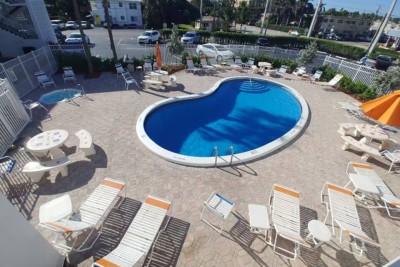
In Southeast Florida, coastal air does the damage that use does everywhere else. Salt reaches inland further than owners expect, and it finds the fasteners first. Steel hardware on an otherwise sound aluminum frame will rust, stain the frame, and seize long before the frame shows anything.
In the Triangle, the problem is different and seasonal. Pollen coats everything in spring, tree cover keeps cushions damp, and anything that holds water grows something. Open-weave cushions that drain and dry, and covers that come off to be washed, are the difference between outdoor space that gets photographed and outdoor space that gets apologized for.
The practical version of all of this is short. For each piece, name how it is going to fail in a rental, then buy the version that fails slowest or recovers cheapest.
| Piece | How it actually fails in a rental | What to specify instead |
|---|---|---|
| Sofa | One stain on a cover that cannot be removed | Removable washable covers, or a performance fabric rated for contract use; darker mid-tones over light naturals |
| Dining chairs and bar stools | Wobble at the leg-to-seat joint from leaning and dragging | Metal frames, or wood with corner blocks and bolts; welded or through-bolted footrests on stools |
| Dressers and nightstands | Drawer slides tearing out of engineered panel; edges swelling in humidity | Solid wood or plywood carcass, metal ball-bearing slides with a positive stop, sealed edges |
| Bed frames | Loosening and squeak; center sag under the mattress | Welded metal or platform frames with a center rail and center leg; check for movement at every walkthrough |
| Mattresses | Body impressions and stains that a protector would have prevented | Firmer medium feel that suits more body types, plus a zippered waterproof protector treated as a consumable |
| Coffee and side tables | Ring marks and chipped veneer edges | Solid wood, stone, or metal tops; avoid veneer edges at standing height and high-gloss finishes that show every mark |
| Rugs | Absorbed spills and matted traffic lanes | Low-pile machine-washable or indoor-outdoor construction in a pattern that hides traffic; skip jute and sisal indoors |
| Outdoor seating | Corroded hardware near the coast; damp cushions inland | Marine-grade or stainless fasteners, powder-coated aluminum, quick-dry foam with removable washable covers |
| Lamps and small decor | Knocked over, broken, or walking out the door | Weighted bases, hardwired or wall-mounted fixtures where possible, and nothing whose replacement requires a specialty order |
Most of this can be settled at the point of purchase with four questions.
National management companies publish furnishing standards, and the standards are not stupid. They are just written once and applied everywhere, because that is the only way a company operating in dozens of metros can operate at all. A single list cannot simultaneously be right for a dry mountain market and for a house eight blocks from the ocean in Pompano Beach.
That is a structural limitation, not a failure of effort. The fastener that is fine in Denver rusts in Deerfield Beach. The cushion that dries in an afternoon in Phoenix stays damp under tree cover in Durham. Knowing which is which requires someone who resets houses in your market and sees what comes back broken, and that knowledge does not travel up to a national procurement list in any useful form.
Furniture in a rental is a depreciating asset you will buy more than once. Treating the initial furnishing as a one-time project and then being surprised every time something needs replacing is a version of a bigger mistake: treating a short-term rental as passive income rather than as a small hospitality business.
The income is passive for the owner when someone else is doing the work. The work does not stop existing. Somebody is still deciding which sofa to buy, noticing that the barstool has developed a wobble, and replacing the mattress protector before a guest finds the reason it needed replacing. Budget for replacement from the first year, keep a short list of what you own and where you bought it, and make the durability decision at purchase — because that is the only moment when it is free.
Stay Maven manages short-term rentals in the Triangle — Raleigh, Durham, and Chapel Hill — and across Southeast Florida from Miami up through Delray Beach. If you want a straight read on what your property could earn and what it would take to run it properly, request a free revenue estimate and we will put real numbers to your address.
